Mathematics
Welcome To
Mathematics
Our Vision for Mathematics
At St John’s Stonefold CE Primary School, mathematics is central to our ambitious and inclusive curriculum. Rooted in our vision of being “Rooted and Established in God’s Love: Nurture, Grow, Fly” (Ephesians 3:17), we aspire to develop confident, resilient and enthusiastic mathematicians who enjoy challenge, think critically and believe in their own ability to succeed.
Guided by our Christian EAGLE values of Empathy, Aspiration, Generosity, Love and Endurance, we provide a learning environment where mistakes are valued as part of learning and every child is encouraged to persevere, reason and problem solve. We want pupils to develop a secure understanding of mathematical concepts and leave St John’s Stonefold as confident, capable learners who can apply mathematics successfully in everyday life and future learning.
Intent
Our mathematics curriculum is designed to:
- Develop fluent and confident mathematicians.
- Foster a positive attitude and enjoyment of mathematics.
- Build deep conceptual understanding through carefully sequenced learning.
- Develop mathematical reasoning and problem-solving skills.
- Ensure pupils can explain, justify and communicate their mathematical thinking.
- Promote independence, resilience and perseverance.
- Equip pupils with strong number sense and secure calculation skills.
- Ensure all pupils, regardless of starting point, achieve success and make strong progress.
- Prepare pupils for the next stage of their education and future life opportunities.
Implementation
At St John’s Stonefold, mathematics is taught using the White Rose Maths scheme as the basis for curriculum planning. Learning is carefully sequenced to build upon prior knowledge and develop secure understanding over time.
Teaching follows an effective:
I Do -> We Do -> You Do
approach where:
- New learning is explicitly modelled.
- Concepts are explored collaboratively.
- Pupils apply learning independently.
A strong emphasis is placed on:
- Fluency.
- Mathematical reasoning.
- Problem solving.
- Mathematical talk.
- Precise mathematical vocabulary.
- Daily arithmetic practice.
- Times-table fluency.
- Overlearning of key concepts.
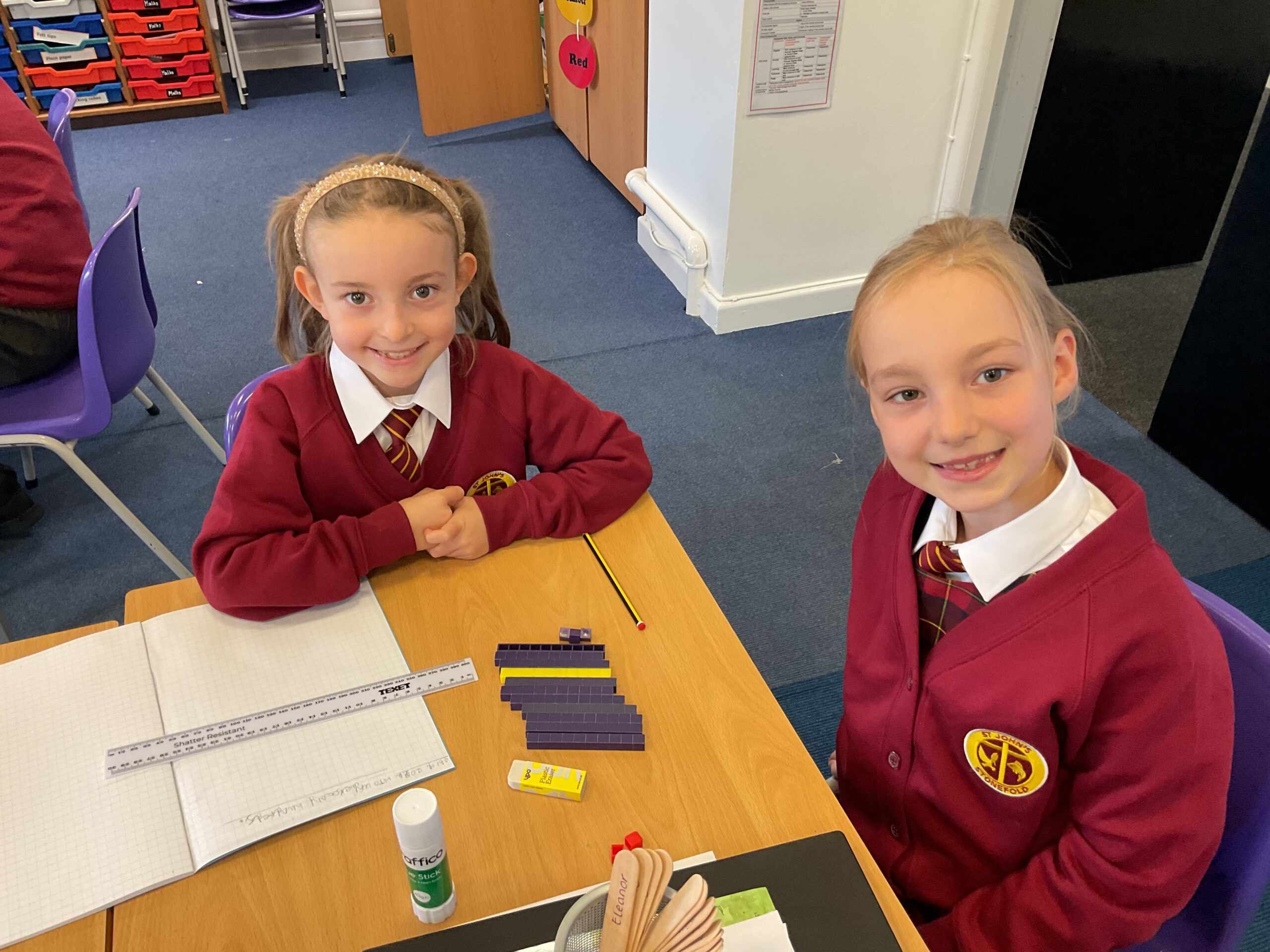
Teaching is supported through the Concrete-Pictorial-Abstract (CPA) approach, enabling pupils to develop a deep conceptual understanding before moving to abstract methods. Manipulatives and visual representations are used throughout the school to support learning and address misconceptions.
Progression Through School
EYFS
Children develop early mathematical understanding through practical exploration, counting, pattern, comparison, subitising and problem solving. They develop a deep understanding of number to ten and begin to explore composition, calculation and pattern.
Key Stage 1
Pupils develop secure number sense, confidence with place value, basic calculation strategies and mathematical language. Learning focuses on developing fluency whilst applying mathematics through reasoning and practical problem solving.
Lower Key Stage 2
Children develop efficiency, accuracy and flexibility in calculation. They deepen understanding of multiplication and division, fractions, measure and geometry whilst increasingly explaining and justifying their reasoning.
Upper Key Stage 2
Pupils demonstrate increasing independence when selecting strategies, tackling complex problems and reasoning mathematically. They develop a secure understanding of fractions, decimals, percentages, ratio, algebra and advanced calculation methods, preparing them for secondary mathematics.
Fluency, Reasoning and Problem Solving
Our mathematics curriculum is built around the three National Curriculum aims:
Fluency
Children develop rapid recall of number facts, multiplication tables and efficient calculation methods through daily practice and overlearning.
Reasoning
Pupils are encouraged to explain, justify and prove their mathematical thinking using precise mathematical vocabulary and sentence stems. Mathematical talk is embedded within every lesson.
Problem Solving
Children apply mathematics in a variety of contexts and are encouraged to investigate, make connections and choose appropriate strategies independently.
Mathematical Vocabulary
We recognise that language is fundamental to mathematical success. Mathematical vocabulary is explicitly taught, modelled and revisited throughout the curriculum. Vocabulary progression is carefully planned from EYFS through to Year 6 to enable pupils to communicate their thinking accurately and confidently.
Examples include:
- Place value language.
- Calculation vocabulary.
- Fractions and decimals.
- Geometry terminology.
- Statistical language.
- Reasoning and problem-solving vocabulary.
Supporting Every Learner
We are committed to ensuring that all children succeed in mathematics.
High-quality adaptive teaching includes:
- Concrete resources.
- Manipulatives.
- Visual models.
- Scaffolded learning.
- Targeted questioning.
- Mathematical talk.
- Structured interventions where required.
Additional challenge is provided through reasoning, justification and greater-depth problem-solving opportunities so that all pupils, including our most able mathematicians, can flourish.
Impact
By the time pupils leave St John’s Stonefold, they will:
- Demonstrate fluency across all areas of mathematics.
- Apply mathematical knowledge confidently and accurately.
- Explain and justify their thinking using precise mathematical vocabulary.
- Solve problems independently using a range of strategies.
- Show resilience and confidence when faced with challenge.
- Understand how mathematics relates to everyday life.
- Be well prepared for the next stage of their mathematical education.
They will leave us as confident, capable mathematicians who embody our EAGLE values and are equipped with the knowledge and skills needed to thrive in future learning and life.
What Makes Mathematics Special at St John's Stonefold?
- A mastery-inspired curriculum built on White Rose Maths.
- Consistent use of the Concrete-Pictorial-Abstract approach.
- Daily arithmetic and times-table fluency practice.
- Strong focus on mathematical reasoning and communication.
- High-quality adaptive teaching for all learners.
- Explicit teaching of mathematical vocabulary.
- Rich opportunities for problem solving and investigation.
- A culture where mistakes are valued and perseverance is celebrated